
Yes, AI can solve maths. It can write code, summarise a hundred reports before lunch and spot patterns none of us would ever see.
I work with AI every day. I design AI teams for a living. I'm not here to tell you it isn't brilliant.
But there's still a hell of a lot AI doesn't know.
It only knows what it knows.
What the "singularity" story assumes
You've probably heard the story. Keep scaling the models, feed them more data, add more compute, and one day machine intelligence overtakes ours. The so-called singularity.
Underneath that story is a big assumption: that intelligence is mostly computation over the data we've captured.
But what about everything we haven't captured? What about the knowledge that was never written down, never digitised, or was never meant to be shared?
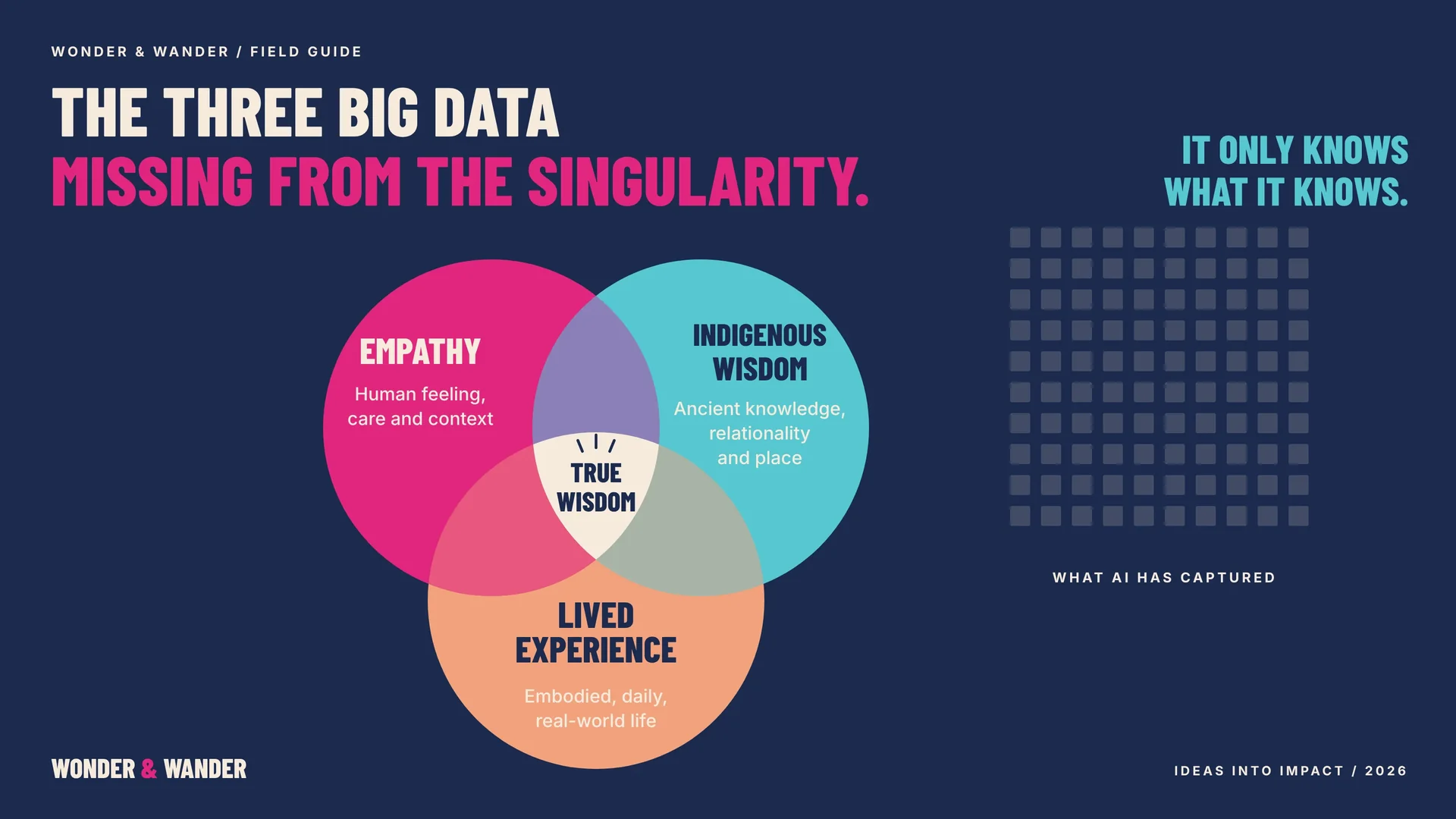
When I look at what's missing, I see three huge bodies of knowledge. I call them the three big data missing from the singularity.
1. Empathy
Empathy isn't a dataset. It's felt.
It lives between people. It's the moment you sit with someone in a hard conversation and know, without anyone saying it, that now isn't the time to fix things. It's in tone, in silence, in a hand on a shoulder.
AI can describe empathy. It can produce words that sound kind, and sometimes that's genuinely helpful. But producing the language of care isn't the same as caring, or as being in relationship with someone over time.
Empathy is relational and embodied. It's built through presence and trust, and most of it never makes it into text.
So the models learn the words. They don't learn the weight of them.
It only knows what it knows.
2. Indigenous wisdom
I want to be careful here, because this isn't my knowledge to speak for.
I live and work between Melbourne and Whangaparāoa in New Zealand, and I'm a learner in this space. What I can say is what I've learnt from listening.
Indigenous knowledge systems are often oral, place-based and intergenerational. They're relational, connecting people, land, water, ancestors and community. And they're held under cultural protocols about who can know what, when, and how it's shared.
A lot of that knowledge isn't on the internet. And a lot of it rightly isn't.
That matters. Indigenous knowledge isn't simply data to be scraped. It belongs to peoples and communities, and they have the right to decide how it's held, shared and used. Some of it shouldn't be in a training set at all.
This is where the work on Indigenous data sovereignty is so important, and it's led by Indigenous peoples themselves. The CARE Principles for Indigenous Data Governance from the Global Indigenous Data Alliance set out collective benefit, authority to control, responsibility and ethics. In New Zealand, Te Mana Raraunga, the Māori Data Sovereignty Network, leads this work. In Australia, Maiam nayri Wingara, the Aboriginal and Torres Strait Islander Data Sovereignty Collective, does too. If you're building with AI, start by reading their work.
So when someone says AI will soon "know everything", I ask: whose everything?
It only knows what it knows.
3. Lived experience
The third missing data set is the one we all carry.
Lived experience is the tacit knowledge in our bodies, our communities and our moments. The nurse who can tell something's wrong before the numbers move. The parent who knows which kind of quiet means trouble. The community that knows why the last program failed, because they lived through it.
Most of that never gets written down. It's passed on by doing, by watching, by being there.
In 22 years of design and innovation, the best insights I've seen rarely came from a spreadsheet. They came from people telling us what it's actually like. From observation. From sitting in the real place where the real thing happens.
AI can process everything we've documented. But lived experience is mostly undocumented, and the people with the most of it are often the least represented in the data.
It only knows what it knows
Here's the edge I want to leave you with.
An AI model can only reason over what it's been given. If empathy, Indigenous wisdom and lived experience are missing, thin or misrepresented, the model won't flag the gap. It will fill it, confidently.
That's not a reason to fear AI. It's a reason to design it well.
In my last post, Beyond the Double Diamond, I wrote that humans bring intention, lived experience, imagination, ethics and judgement. This is why. Those aren't nice-to-haves sitting beside the technology. They're the knowledge the technology doesn't have.
That's why humans stay at the centre. And it's why AI design needs these voices in the room.
What this means for leaders and teams building with AI
This is the hopeful part. You can do something about it this week.
- Put lived experience in the room. Involve the people your AI will affect from the start, not just at testing. Treat their knowledge as expertise, because it is.
- Ask whose knowledge is missing. Before you trust an output, ask who isn't represented in the data, and who should be helping you interpret it.
- Respect consent and data sovereignty. Don't feed community or cultural knowledge into AI tools without clear permission. Where Indigenous data is involved, learn from the CARE Principles and follow the lead of Indigenous data sovereignty networks.
- Build in human decision gates. Let agents research, draft and test. Put people with judgement and lived experience at the points where decisions affect real lives.
- Design for empathy, not just efficiency. Ask where a human conversation matters more than a faster answer, and protect it.
- Make listening part of the process. Budget real time for relationships. Trust isn't a step you can automate.
The intelligence that matters most
The singularity story imagines intelligence as something that can be fully captured, scaled and surpassed.
I don't think that's the whole story. Some of the most important intelligence we have is felt, held, lived and shared between people. It lives in relationships and places. It's carried across generations.
AI can be an extraordinary partner. But it only knows what it knows. The rest is up to us.
If this resonates, I'd love to hear from you. Get in touch at sarah@wonderandwander.com, or follow along as I keep exploring how humans and AI can work together well.
Sarah Pirie-Nally, CEO, Wonder & Wander