
Beyond the Double Diamond: How Humans and AI Agents Innovate Together
Diverge with intelligence. Converge with wisdom. Evolve with evidence.
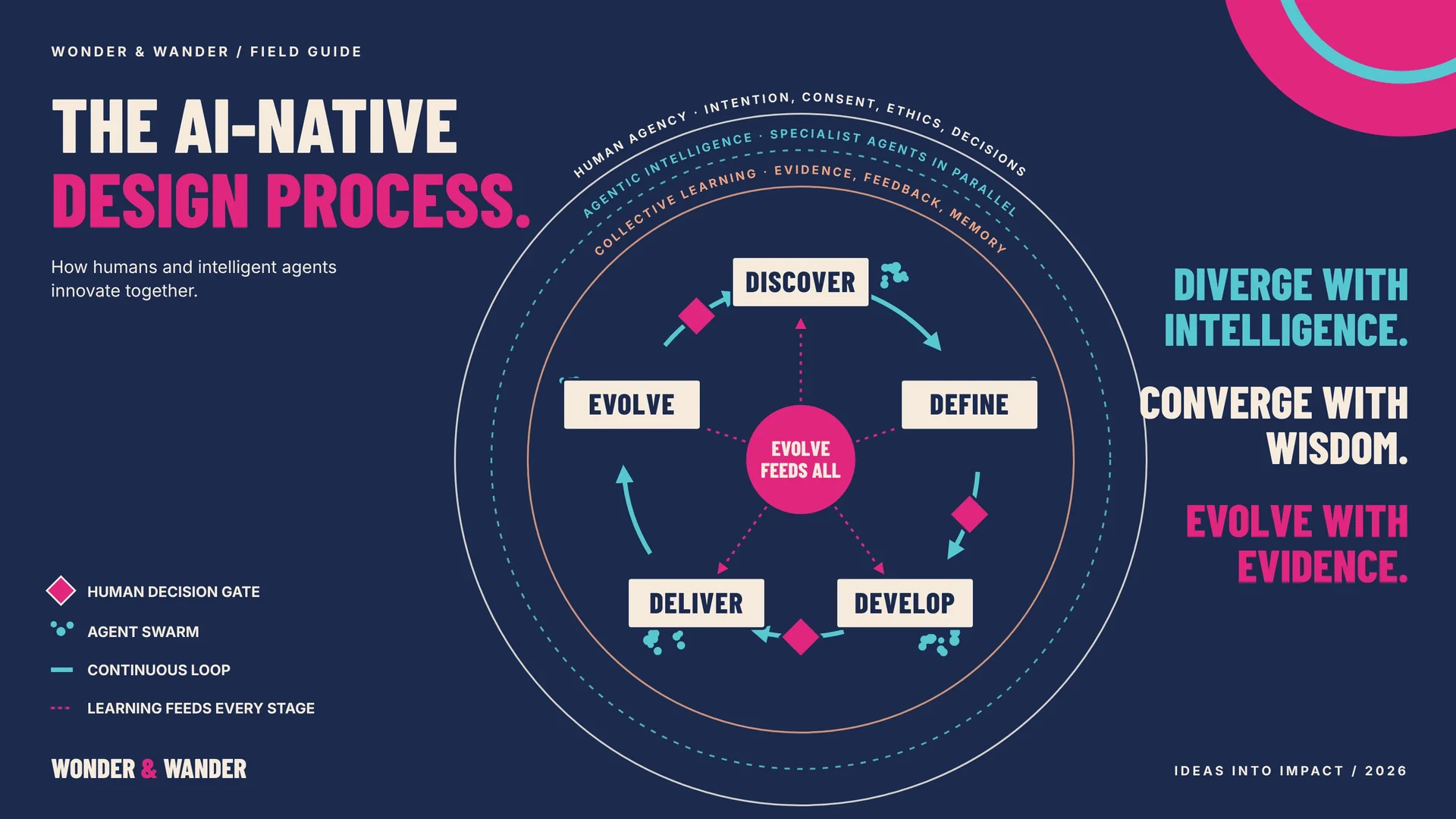
For most of my 22 years in design and innovation, I've drawn the process the same way. Two diamonds. Open up, narrow down. Open up again, narrow down again. Then ship it, and maybe circle back if there's time and budget left.
It's a good model. But I don't think it describes how innovation works anymore.
Because the room has changed. There are new collaborators at the table, and they don't sleep, they don't get bored, and they can explore a hundred directions while we're still making coffee. I know, because I work alongside a team of AI agents every day. I design AI teams for a living.
So I've gone back to my own model, the Wonder & Wander five stages, and asked a harder question. Not "where can we add AI?" but "what does design look like when humans and intelligent agents genuinely innovate together?"
My answer is what I'm calling the AI-Native Design Process.
Why "AI-enhanced" isn't enough
Here's what I see a lot of right now. Teams take their existing design thinking process and sprinkle AI tools on top. A chatbot for interview summaries. An image generator for moodboards. A writing tool for the pitch deck.
Useful, yes. But that's AI-enhanced, not AI-native. It keeps the old shape and just speeds up some steps.
The problem is that the old shape assumed human limits. We converged early because we couldn't explore everything. We tested late because prototyping was expensive. We treated learning as a final stage because there was never time to learn while we were doing.
Those limits are shifting. If we only speed up the old process, we miss the bigger opportunity: to fundamentally rethink how humans and intelligent agents innovate together.
In an AI-native process, the double diamond becomes a dynamic, continuously learning system.
Humans bring intention, lived experience, imagination, ethics and judgement.
AI brings computational scale, synthesis, simulation and execution.
Neither replaces the other. The magic is in how they're designed to work together.
The five stages, reimagined
I've kept the five original stages. They still matter. What's changed is what happens inside each one, and who does what.
| Stage | Human intelligence | Artificial intelligence |
|---|---|---|
| Discover | Curiosity, immersion, empathy | Continuous sensing, research, pattern recognition |
| Define | Meaning, judgement, intention | Synthesis, reframing, challenging assumptions |
| Develop | Imagination, taste, co-creation | Parallel ideation, simulation, rapid prototyping |
| Deliver | Decisions, relationships, accountability | Agent orchestration, execution, testing |
| Evolve | Reflection, wisdom, stewardship | Continuous evaluation, adaptation, feedback |
Discover: explore the possibility. The original methods still hold: immersion, interviews, observations, self-documentation, sitting with real people in real moments. That's human work, and it's where empathy lives. What's new is that AI can keep sensing in the background, running research and spotting patterns across far more signals than any one of us could hold in our heads.
Define: find the focus. We used to interpret findings, identify themes, sort and condense, and frame the design challenge. We still do. But now AI can synthesise at scale, offer alternative framings and, importantly, challenge our assumptions. The human job is meaning, judgement and intention: deciding which problem is actually worth solving.
Develop: turn ideas into options. Brainstorms, jams, charrettes, sketching and graphic recording don't disappear. They get a partner. AI can ideate in parallel, simulate how options might play out and prototype rapidly. What it can't supply is taste. Humans bring imagination and co-creation, and we decide what's actually good.
Deliver: bring it to life. Prototyping, role-play, storytelling, getting feedback and defining success are still the heart of delivery. Now agents can be orchestrated to execute and test, often in parallel. But decisions, relationships and accountability stay with people. Someone has to own the outcome, and it should be a human.
Evolve: scale, learn, repeat. Tracking learnings, celebrating achievements, building partnerships, engaging others and reminding people what changes. This was always the stage that got squeezed. Now AI can continuously evaluate, adapt and feed back, while humans bring reflection, wisdom and stewardship.
Evolve feeds every stage
This is the biggest shift, so I want to be really clear about it.
Evolve is no longer the end of the process. It feeds every stage.
In the old model, learning came last. You delivered, then you reflected, then you started again. In an AI-native process, learning is constant. Every interview, every prototype, every test, every decision creates evidence. That evidence flows straight back into Discover, Define, Develop and Deliver, not just at the end of a project, but all the time.
Three continuous layers
To make that system work, I'm introducing three continuous layers that run underneath all five stages.
1. Human agency: intention, consent, ethics and decision-making. This layer is non-negotiable. Humans set the purpose, decide what's okay and what isn't, and make the calls that matter. AI can recommend. People decide.
2. Agentic intelligence: specialist agents collaborating in parallel. Not one generic assistant, but a team of specialist agents, each with a clear role, working at the same time. This is the part I live and breathe. I run a team of named AI agents, and the lesson I keep relearning is the one behind my Team, Not Mess framework: agents only work well when they're designed like a team, with clear roles, handovers and someone accountable.
3. Collective learning: evidence, feedback and institutional memory. The layer that stops organisations from forgetting. What we tried, what worked, what didn't, and why. Captured, shared and available to both humans and agents next time.
The new innovation metric
For years, the pitch for AI has been speed. Faster research, faster ideas, faster output.
The new innovation metric isn't simply speed. It's how effectively we turn learning into meaningful, measurable value.
A team that moves fast but doesn't learn will just make mistakes more efficiently. A team that turns every cycle of learning into real value for real people is the one that wins.
Diverge with intelligence. Converge with wisdom. Evolve with evidence.
That's the principle at the heart of the methodology. Let AI help us go wider than we ever could alone. Let human wisdom decide where to land. And let evidence, not ego or habit, shape what happens next.
What this looks like on Monday
Here's how to start using this this week.
- Name your decision gates. Before you kick off, decide where a human must say yes before work moves on. A good starting point: after Define (is this the right problem?), before Deliver (is this ready for real people?) and before anything scales in Evolve (should we do more of this?).
- Give agents roles, not just tasks. Instead of "summarise these interviews", set up a research agent, a synthesis agent and a challenger agent whose job is to poke holes in your assumptions.
- Run options in parallel. In Develop, ask for several genuinely different directions at once, then bring the humans in to judge with taste and context.
- Write down consent and ethics up front. What data can agents use? What should they never do? Make it explicit in the human agency layer.
- Capture learning as you go. Don't wait for the retro. Keep a shared learning log that both your people and your agents can read.
- Measure value, not velocity. At each gate, ask: what did we learn, and what value did it create?
The visual is evolving
The image with this post is the first AI-native version of the model. The double diamond has become a loop. Agent swarms work alongside each stage, three human decision gates keep people in charge, and Evolve sits at the centre, feeding every stage.
It's still a first concept, and I'll keep evolving it as the methodology does: showing more of how agents collaborate in parallel, where the decision gates sit, and how evidence flows back through the system. The goal is for it to look less like a diagram you follow and more like a system that's alive.
I see this becoming Wonder & Wander's signature human–AI innovation methodology, not simply an AI-enhanced design thinking framework.
Let's build it together
I'm developing this in the open, and I'd love your thinking. Where would you put the decision gates? What does collective learning look like in your organisation? What have you learnt from working alongside agents?
Get in touch, or follow along as the model and the visual evolve. This is a process about learning, after all. It should learn from you too.
Sarah Pirie-Nally, CEO, Wonder & Wander