
The New Leadership Imperative: Taste
Why curation and creative direction are the most underrated — and most urgent — skills of the AI era.
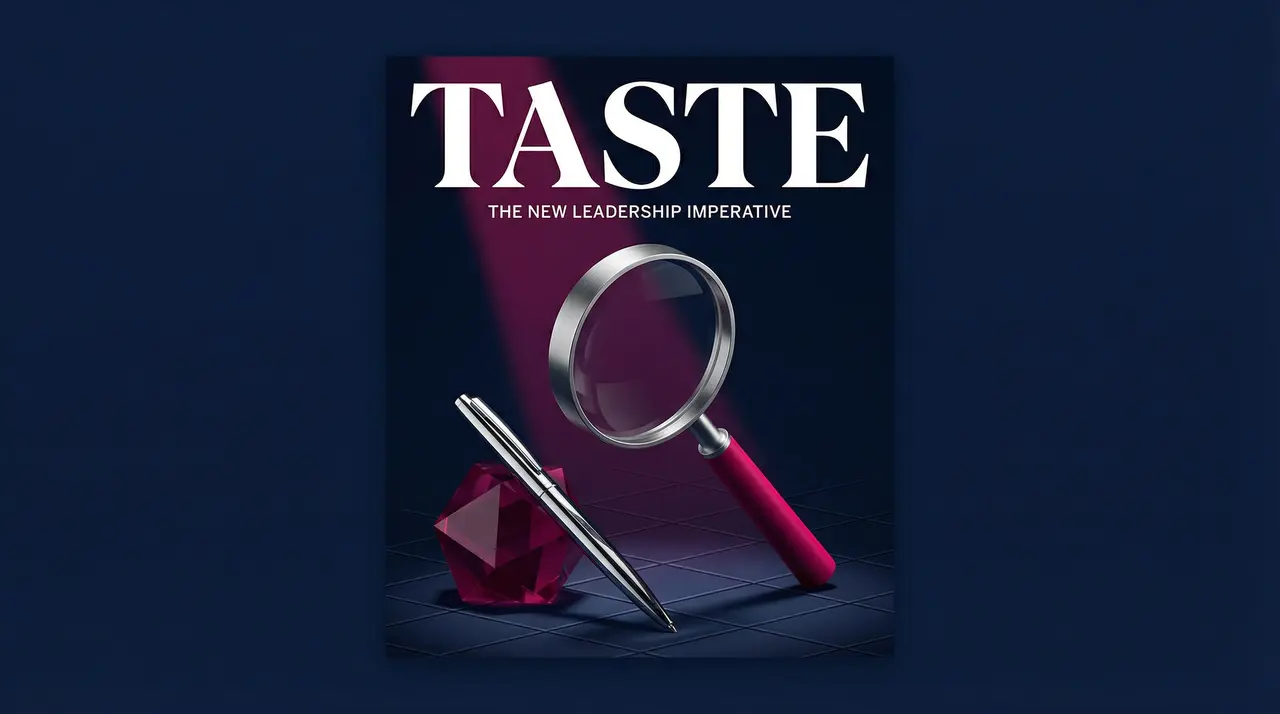
There is something nobody is saying loudly enough about the age of AI: the problem was never about access to intelligence. It was always about what we choose to do with it. And now that intelligence is essentially infinite, abundant, and available to everyone — the only thing that distinguishes remarkable work from mediocre work is taste.
Taste. Not technology. Not prompt engineering. Not even strategy, in the traditional sense. The capacity to discern what is good, what is resonant, what is true to something — and to hold that standard with unwavering conviction even when the machine is offering you a thousand faster alternatives.
This is what I have been sitting with for the past year working at the intersection of AI, human experience, and organisational change. And I want to name it plainly: we are entering an era that will separate leaders who curate from leaders who merely consume. And the distance between those two groups will define the organisations — and the brands — of the next decade.
When Everything Is Possible, Nothing Is Distinctive
AI has collapsed the cost of production to nearly zero. A campaign that took a creative agency four weeks now takes four hours. A brand strategy document, an onboarding journey, a product description, a visual identity — all of it can be generated, iterated, and delivered at a speed that would have seemed absurd three years ago.
And the output is often… fine. Competent. Coherent. Not wrong.
But fine is not a strategy. Competent is not a differentiator. And coherent has never, in the history of culture, moved anyone to feel something.
"The machine will always give you something. The question is whether you know what you are actually looking for."
This is the paradox that organisations are sleepwalking into. The democratisation of production has created the illusion that creative direction is no longer a specialised skill — that anyone can now generate beautiful things, compelling things, strategic things. What it has actually done is raise the floor while simultaneously crowding it. The average quality of AI-generated output is rising. But average is not where brands live. It is not where trust is built. It is not where customers fall in love with something.
Creative direction — real creative direction — is the capacity to see past the competent option toward the true one. To know, in the body as much as the mind, when something resonates versus when it merely reads well. That capacity is not automated. It is cultivated.
What Taste Actually Is
A working definition
We tend to treat taste as something rarefied — the province of designers and editors and art directors with particular training and sensibilities. But taste, in its most essential form, is simply the disciplined accumulation of discernment. It is developed through attention: paying close, sustained, curious attention to what moves people and why.
Leaders with taste have usually done three things over many years. They have consumed widely and intentionally — not just in their own industry, but across art, culture, literature, design, architecture, music. They have developed strong opinions and been willing to defend them. And they have made decisions, often uncomfortable ones, to hold a standard even when the easier path was to accept something adequate.
A distinction worth making: Taste is not the same as preference. Preference is personal. Taste is relational — it understands what a specific audience needs to feel, in a specific context, to produce a specific response. A leader with taste can set aside their personal aesthetic to serve the truth of the work. This is why taste is a leadership skill, not just a creative one.
In an AI-mediated world, taste becomes the meta-skill above all others. Because AI does not have it. Not really. It has pattern recognition at extraordinary scale. It has coherence. It has the appearance of style. But it cannot feel whether something is true. It cannot know whether a piece of copy has the quality of a held breath — that particular tension that means a reader is with you, fully, in this moment.
That knowing lives in human beings. And in the age of AI, cultivating it is not a creative luxury. It is a business imperative.
The Self-Regulation Crisis Nobody Is Talking About
Here is what I am watching happen in real time, across the organisations and founders I advise: the speed of AI is outpacing the wisdom of its users. Not because the tools are bad. Because the humans using them have not yet developed the internal architecture to use them well.
Self-regulation — in the psychological sense — refers to the capacity to manage impulses, delay gratification, and maintain a chosen standard in the face of easier alternatives. In the context of AI-assisted leadership, it means something very specific: the ability to resist publishing the first thing the model generates, to resist the seduction of speed, and to hold creative decisions to a higher standard than "this will do."
"Speed without discernment is not efficiency. It is just faster mediocrity."
The leaders who are thriving with AI are not the fastest adopters. They are the most regulated ones. They use AI as a creative accelerant while maintaining an internal compass that is completely their own. They know what they stand for, what their organisation's voice actually sounds like, what their customers need to feel — and they use that compass to curate ruthlessly from everything the machine produces.
The leaders who are struggling are producing more output than ever and wondering why nothing lands. They are moving fast and feeling hollow. They are shipping competent things that no one remembers.
Five Practices for Leaders Who Want to Lead With Taste
The work of developing discernment
-
Develop a point of view before you open the tool. Before you ask AI for anything, know what you want the output to feel like. Not what information you need — what emotional truth you are trying to serve. The clearer your creative intention, the better your ability to curate what comes back.
-
Build a reference library outside your industry. The best creative directors study everything — fashion, architecture, editorial photography, long-form journalism, poetry. Your competitors are all feeding AI the same industry inputs. Your distinctive voice comes from what you bring that they cannot replicate.
-
Practice the pause. Set a personal rule: nothing goes out the door the same day it was generated. Not always possible, but as a default? This single practice raises quality more than almost anything else. The pause is where taste operates.
-
Name your no. Know what you will not compromise on. Every leader with real creative direction has a list — implicit or explicit — of things they will not do, even when AI makes it easy. Holding this list is an act of identity. It is also what makes a brand legible over time.
-
Invest in your own creative practice. Write by hand. Sketch. Cook. Do reformer Pilates. Make things slowly and deliberately that have nothing to do with your work. The embodied experience of craft — of making something with care over time — is what keeps your creative standards calibrated when you are working at machine speed.
A New Kind of Leadership Literacy
We have spent the last two years talking about AI literacy as if it were primarily technical — learning to prompt, learning to integrate, learning which tools do what. And that matters. But it is not the whole picture, and I think we have underinvested in the more human dimension of what it means to lead in this era.
The leaders who will shape the next decade are not the ones who automated the most. They are the ones who remained most fully themselves while using the tools. Who brought genuine curiosity, genuine perspective, and genuine standards to everything the technology produced. Who understood that curation is not a secondary act after creation — it is the primary creative act of our time.
"The most important design decision of the AI era is the decision to care about quality when no one is forcing you to."
This is what I mean when I talk about conscious customer experience. Not just the deployment of AI touchpoints across a journey, but the human judgment — the taste, the care, the creative direction — that shapes what those touchpoints actually feel like. Experience design has always been fundamentally about what it feels like to be a customer of your organisation. AI accelerates your capacity to shape that experience. It does not replace the wisdom needed to shape it well.
The leaders I most admire in this moment are doing something quietly remarkable. They are learning the tools and holding their standards. They are moving faster and caring more. They are using AI to amplify their voice, not to substitute for it. And in doing so, they are building something that no model can replicate: a body of work that feels unmistakably like them.
In closing
Taste is not a soft skill. In the age of AI, it is a strategic asset of the highest order. It is the capacity that determines whether you build a brand or a commodity, a culture or a process, a legacy or a timeline that no one remembers past next quarter.
The future belongs to the editors. To the curators. To the leaders who know not just how to use the machine, but how to sit with the output and ask, honestly: is this true? Is this us? Is this worth sending into the world?
That question — simple, demanding, deeply human — is the creative act that no AI will ever replace.