
Context. Content. Point of View.
Why the Double Diamond is the most powerful AI framework you already know — and why most leaders are using it in reverse.
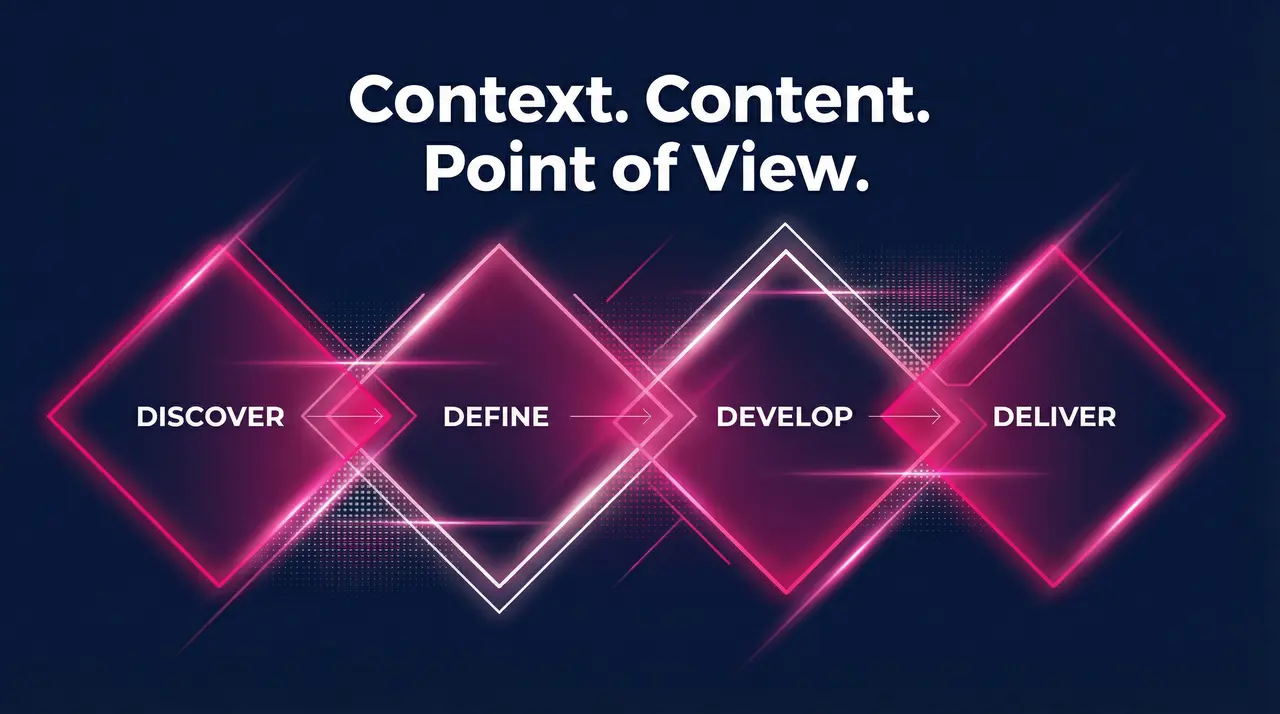
Every CEO I speak with right now has the same look when they describe their organisation's AI output. A slight wince. A pause. "It's fine," they say. "It's just… not quite right." They can't always name what's missing. But they feel it — the way you feel when a room has been decorated by someone who has never met you. Technically correct. Completely hollow.
What's missing is not better prompts. It's not more tools, or a larger budget, or a different model. What's missing is the thing that has always separated great work from adequate work: context, content, and a genuine point of view. The irreducible human ingredients that give intelligence — artificial or otherwise — something real to work with.
And here is the uncomfortable truth: most organisations are feeding AI nothing. A vague brief, a job title, a deadline. Then they wonder why what comes back feels generic. The machine is not failing them. They are failing the machine.
The Three Things AI Cannot Manufacture
What the model needs from you
Context is the world the work lives in. Not just industry and audience, but organisational history, cultural nuance, competitive landscape, what has been tried and failed, what the customer has told you off the record, what keeps your CEO awake at night. Context is the difference between a strategy that could belong to any company and one that could only belong to yours.
Content is the raw material. Real data, real customer voices, real tension points, real stories from the frontline. Not generic research and not AI-generated filler standing in for genuine organisational intelligence. The richness of your input determines the ceiling of your output — every time, without exception.
Point of view is the hardest one, and the one most leaders are most reluctant to name. It is your organisation's genuine stance on something. Not a positioning statement drafted by a consultant. A real belief, held with conviction, that shapes every decision downstream. Without it, AI produces content that reads in all directions at once — technically inoffensive and strategically inert.
"AI amplifies what you bring to it. If you bring a rich point of view, it returns insight. If you bring nothing, it returns noise dressed as content."
This is the fundamental misunderstanding at the heart of most enterprise AI adoption. Leaders treat AI as a content machine — something you plug a topic into and receive a finished asset from. But the most sophisticated users of these tools understand something different: AI is a thinking partner, and like every thinking partner, it is only as good as the quality of the conversation you bring to it.
Enter the Double Diamond
In 2005, the British Design Council formalised something that design practitioners had understood intuitively for decades — that great creative and strategic work moves through two fundamental motions: divergence and convergence, repeated twice. They called it the Double Diamond.
The first diamond is about the problem. You open wide to discover the true nature of what you're facing — research, immersion, listening, exploring. Then you converge to define the right problem to solve, not just the one that was handed to you. The second diamond is about the solution. You open wide again to develop possibilities — ideas, prototypes, experiments. Then you converge to deliver: the singular, refined, executed thing.
It is elegantly simple. It is also exactly the structure that AI-assisted work collapses when leaders are not paying attention.
Most organisations using AI are living permanently in the right half of the second diamond — executing, producing, delivering — without ever doing the divergent work that makes execution meaningful. They are answering questions they have never properly interrogated, for customers they have never deeply understood, with a point of view they have never explicitly chosen.
The Double Diamond does not just describe good design process. In the age of AI, it describes the architecture of good thinking. And the leaders who understand this — who use AI to enrich every stage of the diamond rather than just the last one — are producing work of an entirely different quality.
The AI-Augmented Double Diamond
The four stages of the Double Diamond each require a different relationship with AI — and a different quality of human input.
Stage 01 — Discover (Diamond One · Diverge)
The most neglected stage in AI-assisted work. This is where you immerse yourself in the real world of your customer — their language, their frustrations, their unspoken needs. AI cannot discover for you. But it can help you go deeper, faster.
Context at this stage: Everything you know about your customer before you begin. Their world, their language, their history with you. The richer this is, the better AI can help you find patterns in what they are telling you.
Content at this stage: Raw customer data — interviews, reviews, support tickets, social listening, frontline observations. This is not the stage for AI-generated content. It is the stage for AI-assisted sense-making of real human signal.
Point of view at this stage: Your hypotheses. What do you believe is true about your customer that others might not see? Bring these into your AI conversations as starting assumptions to be tested, not conclusions to be confirmed.
AI tools for Discover: Use ChatGPT or Claude for thematic analysis of interview transcripts. Use Perplexity or Consensus for rapid literature review and trend synthesis. Use NotebookLM to surface patterns across large document sets.
Example prompt for Discover: "Here are 40 customer interview transcripts from our last research round. I want you to identify: the three most emotionally charged moments customers describe, the language they use to describe their problem (not our language — theirs), and any tensions or contradictions in what they say they want versus what they describe actually doing. Do not summarise. Surface the specific, the surprising, and the uncomfortable."
Stage 02 — Define (Diamond One · Converge)
The stage where most AI-assisted projects go wrong. Define is not about generating options — it is about making a choice. The discipline of converging on a single, well-articulated problem statement is one of the hardest things a leadership team can do. AI can help you get there. It cannot do it for you.
Context at this stage: Everything Discover surfaced. The patterns, the tensions, the customer language. Your job is to synthesise this into a problem frame that is specific enough to be useful and true enough to be trusted.
Content at this stage: The synthesis artefacts from Discover — themes, insights, customer quotes, tension maps. These become the raw material for your problem definition work.
Point of view at this stage: This is where your organisational conviction becomes essential. Two teams with identical research can define completely different problems — because their point of view shapes what they see as important. Define is where POV becomes strategy.
AI tools for Define: Use Claude or ChatGPT for problem reframing and "How Might We" generation. Use Miro AI or FigJam AI for brief creation and alignment artefacts.
Example prompt for Define: "Draft a one-page strategic brief based on this problem definition. It should include: the single most important customer insight, the problem statement in one sentence, what success looks and feels like for the customer (not for us), and three things we will explicitly not do in solving this. Write it in plain language that a sceptical CFO and an imaginative designer would both find credible."
Stage 03 — Develop (Diamond Two · Diverge)
This is where most leaders want to start. And it is where AI truly accelerates — but only when Discover and Define have given it something real to work with. Develop without context is the factory of fine.
Context at this stage: The creative brief from Define is your context for everything in Develop. Every prompt begins by reestablishing this frame. AI does not remember your strategy — you must bring it into every conversation.
Content at this stage: This is where content generation begins in earnest. But it is generative, not final. You are producing quantity so you can exercise taste. The discipline is in what you choose — not in what you make.
Point of view at this stage: Your POV is the filter. Every generated option gets assessed against it. Does this feel like us? Does this serve the customer truth we defined? POV in Develop is the curatorial act — the taste that saves you from the competent.
AI tools for Develop: Use Claude or ChatGPT for concept generation and messaging frameworks. Use Perplexity for concept validation and precedent checking. Use Midjourney or Adobe Firefly for visual concept development. Use v0 or Cursor for rapid prototyping.
Example prompt for Develop: "Using this brief as your frame [paste brief], generate five distinctly different conceptual directions for solving this problem. Each should feel like a different bet — not variations of the same idea. For each, describe: the core belief it operates from, the customer feeling it creates, and one thing about it that would make a conservative leader uncomfortable. I want the range, not the average."
Stage 04 — Deliver (Diamond Two · Converge)
The stage where most energy is spent and — when done well — the least creative decision-making happens. Deliver is execution of a clear vision. The choices were made in Define. The direction was set in Develop. Deliver is craft.
Context at this stage: Delivery context is operational: channels, timelines, constraints, stakeholders. AI is extraordinarily effective here — it can adapt a single idea across ten formats, tones, and contexts without losing its essence, if that essence has been clearly defined.
Content at this stage: Final content is curated from Develop's options. The discipline here is editing — not generating more. The most common delivery failure is producing too much and curating too little. Taste is exercised in what you do not publish.
Point of view at this stage: POV at this stage is consistency. Every touchpoint, every format, every channel should feel like it comes from the same coherent perspective. AI will drift without explicit POV anchors in every prompt. Bring your brief to every delivery conversation.
AI tools for Deliver: Use Claude or ChatGPT for multi-format adaptation and voice calibration. Use Perplexity or Brand Watch for competitive monitoring and launch intelligence. Use Midjourney or Canva AI for final asset production. Use Cursor or Framer AI for production builds.
Example prompt for Deliver: "Take this core message [paste approved message] and adapt it for: (1) a 60-second executive briefing, (2) a LinkedIn post that does not sound like LinkedIn, (3) a subject line for an email to a CFO who is skeptical, (4) a single sentence for a slide headline. The voice across all formats should feel like [describe your organisation's voice in three words]. Do not genericise."
The Framework Is Not New. The Stakes Are.
The Double Diamond was not designed for AI. It was designed for human beings who needed a way to think clearly in conditions of complexity and uncertainty. What makes it so powerful in 2026 is precisely that: it is a human framework, which means it is the right container for the irreducibly human work that AI cannot do.
Discovery requires empathy. Definition requires conviction. Development requires taste. Delivery requires craft. AI can accelerate all four stages dramatically. It cannot supply what is missing when none of those qualities are present in the person directing it.
"The leaders who will define the next decade are not the ones who automated the most. They are the ones who thought most clearly about what they were automating — and why."
This is the conversation I am having with every CEO and leadership team I work with right now. Not: how do we use more AI? But: how do we use it with more intention? How do we bring more context, richer content, and a sharper point of view to every interaction with these tools, so that what comes back is genuinely useful rather than generically competent?
The Double Diamond gives you the architecture for that intention. Use it. Not as a process to follow mechanically, but as a reminder of where human thinking is irreplaceable — and where AI, given something real to work with, can take you further than you have ever gone before.