
I Replaced Go High Level, Flodesk, and Half My Tech Stack With One AI System I Built Myself
Most business owners are drowning in tools that don't talk to each other. I spent years in that loop — until I built Pip: a 7-phase AI intelligence layer that replaced my entire fragmented stack with one coherent system.
I Replaced Go High Level, Flodesk, and Half My Tech Stack With One AI System I Built Myself
By Sarah Pirie-Nally
There is a particular kind of exhaustion that comes from managing too many tools. You know the one. You have a CRM that doesn't talk to your email platform. Your email platform doesn't know what your AI chatbot is doing. Your chatbot has no idea someone just purchased your course. And somewhere in the middle of all of it, a real human being — someone who genuinely wants to work with you — is getting a generic welcome sequence that has nothing to do with where they actually are.
I spent years in that loop. Go High Level for CRM and automation. Flodesk for email. Separate tools for lead scoring, chat, and notifications. Each one doing its job in isolation, none of them talking to each other in any meaningful way. The result was a customer experience that felt, at best, adequate — and a backend that required constant human intervention to function.
So I built something different. I called it Pip.
What Pip Actually Is
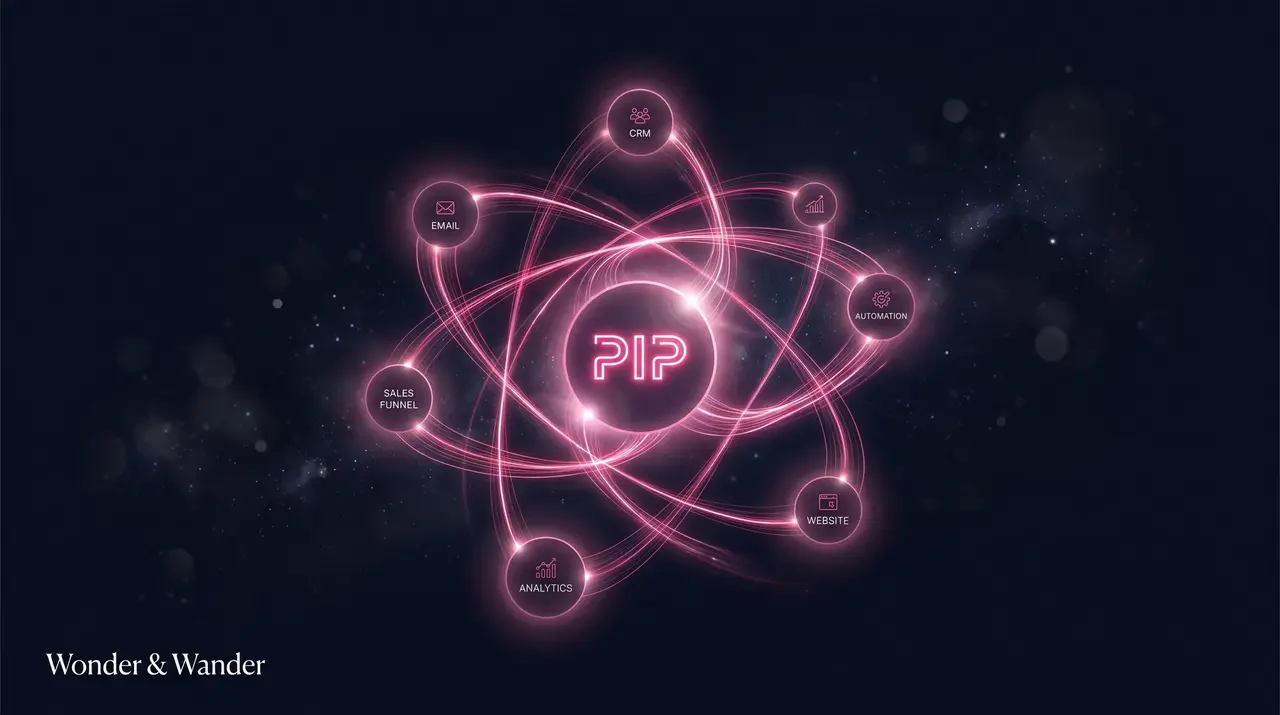
Pip is not a chatbot. It is not a newsletter tool. It is not a CRM in the traditional sense. It is an intelligence layer — a 7-phase AI-powered system that sits across my entire business and makes every customer interaction smarter, faster, and more personal than anything I could manage manually.
The name comes from the persona: Pip is described internally as a "mini Sarah" — firm, knowledgeable, always acting in the customer's best interest. Not vague. Not corporate. Not sending the same email to 4,000 people and hoping for the best.
Here is how it works.
Phase 1 — First Touch: Every Entry Point Feeds the System
Someone discovers my world through one of seven entry points: the Wonder Audit (a free AI fluency assessment), the AI Tea Weekly newsletter, the Pip chat widget on my website, a speaking enquiry form, a course purchase, a School of Wonder enrolment, or a privacy consent request. Every single one of these touchpoints — regardless of where the person came from or what they did — feeds directly into Pip.
This is the first thing that changes when you move from a fragmented stack to an intelligence layer: nothing falls through the cracks. An abandoned checkout is a signal. A newsletter signup is a signal. A 20-minute chat session with the website AI is a signal. All of it is captured, timestamped, and acted on.
Phase 2 — The Intelligence Engine: Six Things at Once, in Seconds
The moment someone enters the system, Pip does six things simultaneously.
It creates or enriches their contact record — new contacts are created, returning contacts are updated, and duplicates are never created. It scores their AI fluency across five dimensions: Awareness, Usage, Strategy, Ethics, and Future Readiness, each scored from 0 to 100. It logs every event in their journey with a timestamp. It computes their Next Best Action — a single, intelligent decision about what should happen next, based on their stage, timing, engagement history, and churn risk. It triggers a personalised email sequence appropriate to where they are. And it sends me a real-time notification if the moment is high-value enough to warrant my personal attention.
This is what I mean when I say AI is the instrument, not the whole thing. Pip does the computation. I do the relationship.
Phase 3 — Fluency Scoring: Three Stages, Three Completely Different Journeys
Based on their Wonder Audit responses, every contact is placed into one of three stages. This is where the system diverges from anything a traditional email platform can do.
Curious (score 0–33) — AI-aware but not yet integrating. Excited, open, ready to learn. Their path: welcome email → nurture content at 48 hours → AI toolkit offer at 96 hours.
Capable (score 34–66) — Using AI regularly, building confidence, ready for structured strategy. Their path: welcome email → nurture content at 48 hours → AI leadership waitlist at 96 hours.
Conductor (score 67–100) — Strategic AI integrators, leading teams, ready for advisory or speaking work. Their path: welcome email → nurture content at 48 hours → book a call with Sarah at 96 hours.
A Curious gets completely different emails, different offers, and different next steps than a Conductor. Not because I am manually segmenting them — but because Pip scored them and routed them automatically. This is the difference between a broadcast and a conversation.
Phase 4 — The Next Best Action Engine: One Decision Per Person, Every Night
Every night at 10pm, Pip runs what I call the daily orchestrator. It checks every contact in the system and makes a single intelligent decision about what should happen next for each one.
The six possible actions are: book a call (for Conductor-stage contacts who haven't yet booked — the highest priority action in the system), send an offer (for Capable contacts ready for AI leadership), nurture (value content for all stages, 48 hours after welcome), alumni upgrade (graduates offered AI leadership seven days after completing AI toolkit), superfan activation (high-engagement contacts scoring 700 or above on the Superfan Score, flagged for personal outreach from me), and churn recovery (contacts silent for 30 or more days, triggered into a re-engagement sequence before being suppressed).
This is not sending the same email to everyone. This is making an intelligent, individual decision for every person in my ecosystem, every single day, without me touching it.
Phase 5 — Automated Email Sequences: Behaviour-Triggered, Not Broadcast
The three core sequences — Welcome, Nurture, and Offer/Recovery — are each triggered by behaviour, not by a calendar. The Welcome sequence fires immediately on entry and is personalised to the contact's stage: a Curious gets a different welcome than a Conductor. The Nurture sequence fires 48 hours later with deeper value content, Wonder Audit insights if applicable, community and social proof, and a soft call to action. The Offer and Recovery sequence fires 96 hours after nurture, or is behaviour-triggered for abandoned checkouts, strategic advisory enquiries, alumni upgrades, and re-engagement.
The tone throughout is warm and human. Not corporate. Not templated. The copy is written to feel like it came from me — because Pip is, in every meaningful sense, an extension of how I think and communicate.
Phase 6 — Outcomes: Superfan or Recovery
Every contact in the system trends toward one of two outcomes. Superfans are identified automatically: Pip computes a Superfan Score from 0 to 1,000 based on multiple purchases, completed audits, high email open rates, chat sessions, referrals, and long tenure. Contacts scoring 700 or above are flagged for personal outreach from me. These are my most valuable relationships — and the system surfaces them without me having to dig.
Churning contacts are caught before they fully disengage. Thirty or more days of silence triggers the re-engagement sequence. If it doesn't work, the contact is suppressed — keeping my list healthy and my metrics honest.
Phase 7 — The Intelligence Dashboard: What I See Every Day
I don't have to dig through anything. Pip surfaces the right information at the right time through six dashboard panels: a daily leads briefing (new leads, their stage, score, and suggested next action), a full contact journey timeline, a ranked Superfan List of my top 50 most engaged contacts, funnel statistics across stages and sequences, a manual override panel (because human judgement always wins), and real-time alerts for new subscribers, qualified leads, and superfan detections.
The override panel matters. I can update any contact's stage, score, or tags at any time. The system is intelligent, but it is not autonomous. I am always in the loop.
What This Replaced
Go High Level. Flodesk. Separate lead scoring tools. Manual CRM updates. Broadcast email campaigns. The mental overhead of managing a fragmented stack.
What I have now is one system that knows where every person is, what they need next, and when to surface them to me for a human conversation. It runs largely without my intervention. And when it does surface something — a superfan, a high-intent lead, a contact at risk of churning — it surfaces exactly the right thing at exactly the right moment.
Why This Matters Beyond My Business
I built Pip because I teach AI implementation, and I needed to practice what I preach. But the deeper reason is this: most business owners are drowning in tools that don't talk to each other, and the solution the market keeps offering them is more tools.
The answer is not more tools. The answer is an operating system — a layer of intelligence that sits across everything you already do and makes it coherent. Pip is my operating system. It is built on AI, but it is designed around human relationships. The machine handles the computation. I handle the connection.
That is the whole philosophy of Wonder & Wander in a single system.
If you want to understand where your own AI fluency sits — and what your next step might look like — the Wonder Audit is the place to start. It takes about five minutes. And yes, Pip will know exactly what to do with you when you finish.
Sarah Pirie-Nally is the founder of Wonder & Wander, an innovation practice specialising in AI strategy, experience design, and leadership transformation. She works with leaders across Australia, New Zealand, and beyond to build the human × AI operating systems that drive meaningful, lasting change.